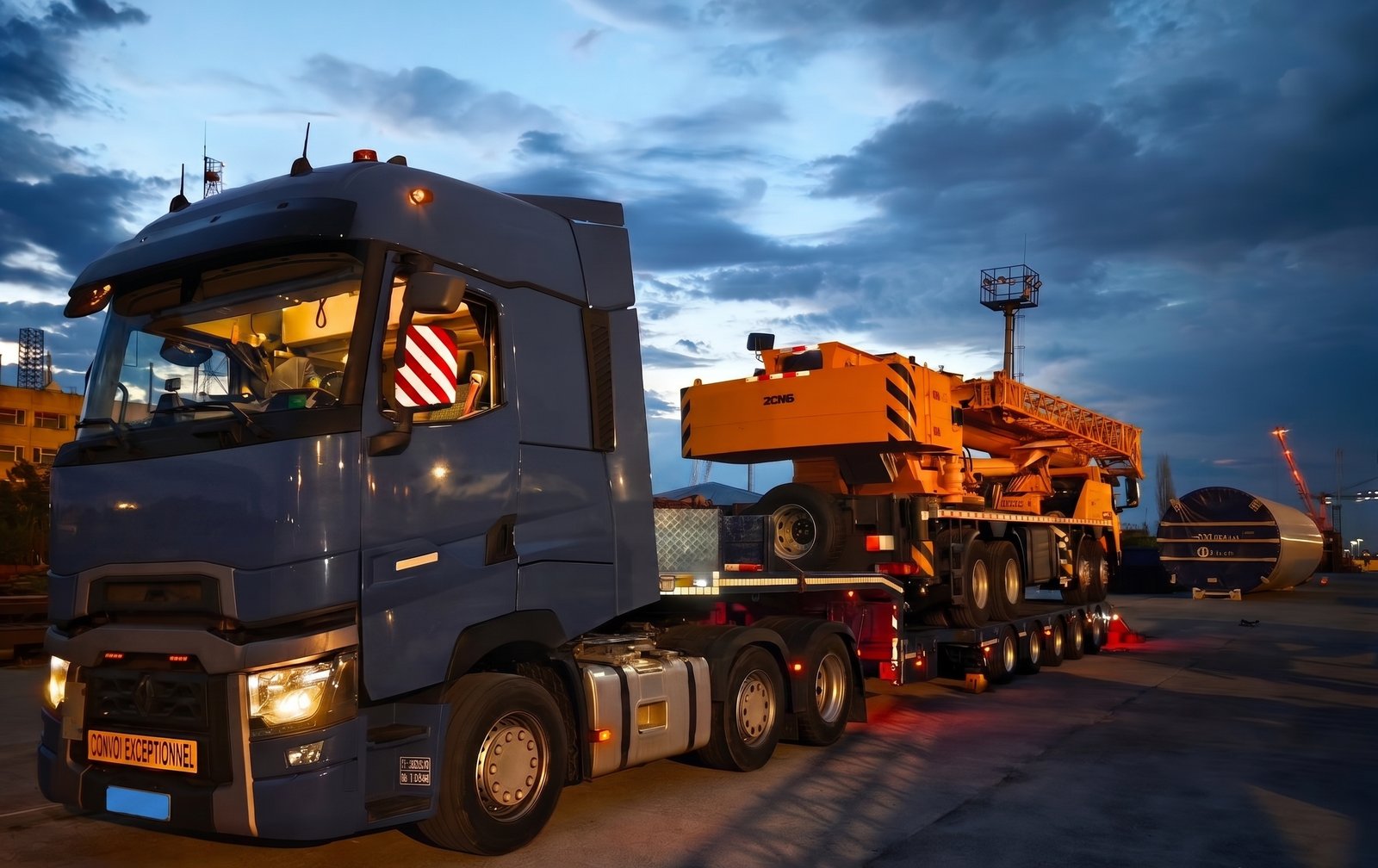
The short answer: there is no single oversized permit for the whole EU — it is issued in each country of the route separately. In Ukraine the processing fee is 95 UAH (190 for urgent), but that is not the whole cost: on top of it comes a road charge based on weight and distance. In other words, the “price of a permit” is not a fixed price list but a calculation for the specific cargo and route. Below — who issues it, how the cost is calculated, how long you wait and what height is allowed without a permit, in the 6 countries of the EU port → Ukraine corridor.
What an oversized permit costs
There is no fixed “price of a permit”. Almost everywhere the cost has two parts: the processing fee + the road use charge, calculated from the excess weight × distance. In Ukraine it looks like this:
- The administrative processing fee — 95 UAH (standard) or 190 UAH (urgent). That is fixed.
- The road charge (Cabinet of Ministers Resolution No. 879) — by weight: above 60 tonnes it is €0.78/km for every 10 tonnes; plus extra for exceeding axle load and dimensions. Paid in hryvnia at the NBU rate.
On light oversized cargo the 95 UAH fee is almost the whole amount. On heavy cargo above 60 tonnes and a long leg, it is the road charge that becomes the main amount — and it can exceed the fee several times over. So the honest answer to “what does a permit cost” is we’ll calculate it for your cargo and route, rather than quoting a figure from a price list.
Who issues it, what it costs and how long it is valid: 6 countries
A run from an EU port into Ukraine passes through several countries, and each has its own authority, its own price and its own timing. Here is the comparison along the corridor Netherlands / Germany → Poland → Romania / Moldova → Ukraine:
| Country | Who issues it | Cost | Processing time | Validity |
|---|---|---|---|---|
| 🇺🇦 Ukraine | The National Police (via the ЦНАП centre or the Ministry of Internal Affairs portal); the route is approved by the Restoration Agency | A fee of 95 / 190 UAH + a road charge in €/km by weight | 3 working days / 1 urgent | Single trip; up to 3 months for a recurring route |
| 🇵🇱 Poland | starosta (categories I–II) or GDDKiA (categories III–VII) | By category: cat. II — PLN 200, cat. IV — PLN 800 and above | 3 working days (I–IV) · 14 days (V, VII) | From a single trip to 12–24 months depending on the category |
| 🇷🇴 Romania | CNAIR (by size: SDN → DRDP → CNAIR) | Processing at 20% of the excess tariffs (min. €10) + a charge for weight/dimensions | ≈ 2 working days (faster if urgent) | A route AST — up to 10 days; there are also 30/90 days and 12 months |
| 🇲🇩 Moldova | ANTA — a single window (HG 326/2022) | A tariff for excess weight/axles/dimensions; payment via MPay | application to autorizatii@anta.gov.md | round trip; the original must be in the cab along the whole route |
| 🇳🇱 Netherlands | RDW | Single — €96; annual — €159/year | Single — up to 14 days; annual — 2 working days | Single — 4 weeks; annual — 1 year |
| 🇩🇪 Germany | The local road authority via the VEMAGS system | A fee of €40–€1,300 per decision (escort charged separately) | ≈ 2 weeks; across bridges — 4–8 weeks and more | Single or annual (Dauererlaubnis) within set weight/dimension limits |
Swipe the table sideways →
Sources: Cabinet of Ministers Resolutions No. 30 and No. 879 (Ukraine); Prawo o ruchu drogowym, GDDKiA (Poland); Ordin MT 1836/2018, CNAIR (Romania); Legea drumurilor 509-XIII, HG 326/2022, ANTA (Moldova); RDW (Netherlands); §29/§46 StVO, VEMAGS (Germany). Current as of 28 July 2026.
There is no single EU permit — and that is the main thing
The most common mistake is to think that one “European permit” opens the whole route. It does not. A German permit is valid only in Germany, a Dutch one only in the Netherlands. For an end-to-end run from a port into Ukraine the permit is issued separately in every transit country, each with its own procedure and timing.
The practical conclusion: the departure date is set not by the permit that is issued quickly, but by the slowest one in the chain. And that is almost always Germany — because of responsibility fragmented across 16 federal states and the recalculation of bridges on the route, the timing stretches to 4–8 weeks. That is why we agree the route before booking, not after the vessel arrives.
How much you can carry without a permit
What height is allowed without a permit is the question every run starts with: it is height that most often, and unnoticed, makes cargo oversized. Here are the thresholds below which a permit is not yet required, along the Constanța → Ukraine corridor:
| Without a permit | EU | Moldova | Ukraine |
|---|---|---|---|
| Height (from the ground) | 4.00 m | 4.00 m * | 4.00 m (4.35 m for container carriers on designated routes) |
| Width | 2.55 m (reefer 2.60 m) | 2.55 m | 2.60 m |
| Length | 16.50 m articulated / 18.75 m road train | ≈ 16.5 m | 22 m road train |
Swipe the table sideways →
Dimensions across the EU are harmonised by Directive 96/53/EC — which is why Romania, Poland, the Netherlands and Germany have the same thresholds. * Moldova: 4.35 m is allowed only for a 2–3-axle tractor with a semi-trailer carrying a 40-foot ISO container in combined transport, and only on 4 designated routes (Tudora–Căușeni–Chișinău, Chișinău–Bălți–Criva, Leușeni–Chișinău–Dubăsari, Chișinău–Giurgiulești). In all other cases — 4.00 m. Sources: Directive 96/53/EC, Legea drumurilor 509-XIII (Moldova), clause 22.5 of the road rules (Ukraine).
Next — the measurement tolerance: by how much you may exceed the norm for it not to be a violation yet. It differs in every country, and in most of the EU there simply is none for height:
| Country | Height tolerance | Weight tolerance |
|---|---|---|
| 🇺🇦 Ukraine | 2% | 2% (gross and per axle) |
| 🇷🇴 Romania | up to 1 cm | 5% gross · 4% per axle |
| 🇲🇩 Moldova | ≈ 5 cm * | +100…250 kg per axle * |
| 🇪🇺 Poland · Netherlands · Germany | there is no official one — the 4.0 m norm is strict | there is no single norm (practice varies) |
Swipe the table sideways →
* Check the Moldovan figures with ANTA before the run. In Romania exceeding the height by up to 1 cm carries no fine; above that — a fine from 100 lei and the need for an AST. The main point: in Poland, the Netherlands and Germany there is no official height tolerance, so “almost 4 metres” is safer treated as “above”.
The container-on-chassis trap: why “almost 4 metres” is already oversized
The most frequent mistake: the client sees “4.0 m” and thinks they have a metre of margin. In reality the margin is eaten by the chassis itself. The external height of the container is not everything; add the deck height. Here is the arithmetic for an empty container:
| Container | External height | A standard chassis (≈1.2–1.5 m) | A low-bed trailer (≈0.5–0.9 m) |
|---|---|---|---|
| 40' Standard / Open Top | 2.59 m | ≈ 3.8–4.1 m — right on the 4.0 m limit | ≈ 3.1–3.5 m — fits |
| 40' High Cube | 2.90 m | ≈ 4.1–4.4 m — over the limit even empty | ≈ 3.4–3.8 m — fits |
| 20' Standard | 2.59 m | ≈ 3.8–4.1 m — on the limit | ≈ 3.1–3.5 m |
Swipe the table sideways →
The deck height depends on the chassis model — measure from the specific one, not from a “standard” figure.
That is exactly why the answer to the real case “a car in a 40-foot open top, 4 metres from the ground, route Constanța → Chișinău” is: on a standard chassis this is already above 4.0 m — you need either a lower trailer or a separate AST in Romania (CNAIR) and in Moldova (ANTA). A Romanian permit is not valid in Moldova, and vice versa.
Ukraine: who issues it and what not to confuse
In Ukraine the permit is issued by the authorised unit of the National Police (Cabinet of Ministers Resolution No. 30); the application is filed through a ЦНАП centre or online on the Ministry of Internal Affairs portal. Before that the route is approved by the road owner — the Restoration Agency (formerly Ukravtodor) on roads of national importance, the regional road service on local ones, or the service responsible for streets. These are two different steps: first the route approval, then the permit.
Ukrtransbezpeka does not issue permits — it runs dimension and weight control on the road and checks the carrier’s licences. Confusing these authorities costs you days.
When an escort is required
Above certain dimensions the permit alone is not enough — an escort is required, and that is a separate cost item. In Ukraine the thresholds are:
- A pilot car — at a width over 3.5 m or a length over 24 m.
- A police escort — at a width over 3.75 m, a length over 30 m, or when the route requires driving into the oncoming lane.
Dimensions are not the only trigger: an escort may also be required by the conditions of the route — the number of lanes, entering built-up areas, difficult sections. In EU countries the thresholds are their own — in Romania, for instance, police are required at a width over 5 m, a length over 40 m or a weight over 80 tonnes, while pilot cars are needed from 3.2 m in width. The specific conditions are always written into the permit itself, so they have to be budgeted before the contract is signed, not after.
Who arranges all of this
Formally the applicant is the carrier. But in practice, assembling a chain of permits in 3–5 countries, agreeing the route with road owners, calculating the road charge and ordering the escort is a separate job — and that is exactly what we take on. The client sees one timeline and one turnkey amount, not six separate procedures with different authorities and deadlines.
That is the difference between “agreeing a freight rate” and moving oversized cargo from the port to the site in a way where no permit becomes the reason for idle time.