Incoterms are eleven three-letter rules that split two things between seller and buyer: cost and risk. Not title. Not payment terms. Only who pays for what, and from which moment the cargo becomes your problem.
The rules in force are Incoterms 2020. No revision is expected before 2030, so what you learn today will hold for years.
The most expensive mistakes happen not where the rule was chosen wrongly. They happen where it was read carelessly: in four rules out of eleven the cost point and the risk point do not coincide. The seller pays freight to Constanta — but the cargo is already yours from Ningbo. Below: a table of all eleven, seven traps from practice, and our case where switching CIF to FOB removed thousands of dollars in demurrage.
What Incoterms do not cover
Half of all disputes start here. The rule in the invoice looks as if it settled everything. It settled two things out of many.
- Title to the goods. Risk and ownership are different things. The moment title passes is written into the contract as a separate clause.
- When and how you pay. Incoterms say nothing about whether it is a letter of credit, prepayment or deferred terms.
- What happens if the wrong goods arrive. That belongs to the sales contract, not to the delivery rules.
- Which court hears a dispute. The rules are international. Courts are not.
A rule is always written together with a named place: FOB Ningbo, CIF Constanta, DAP Kyiv, 4 Promyslova St.. Without the named place the rule is incomplete, and it is exactly the vague “somewhere in the port” that produces the longest email threads.
The table: all 11 Incoterms 2020 rules
The orange dot is where risk becomes yours. The hollow blue one is where the seller's costs end. In group C they are pulled apart, and the band between them shows what you are already liable for while someone else still pays.
Where there is a gap between the dots, the seller is still paying for carriage but the cargo is already yours. That gap is where disputes over who covers the loss begin.
Departure
The seller carries nothing. The buyer collects — from the factory yard.
The seller makes the goods available at their premises. Everything else — loading, export clearance, freight, duty — is on the buyer.
The trap that makes ICC itself advise against EXW. In most countries only a local company can file the export declaration. Under EXW your Chinese supplier is not obliged to, and you physically cannot: no Chinese tax number, no customs registration. The cargo sits at the factory until the seller agrees to file it “as EXW loaded”. ICC explicitly recommends using FCA.
The second EXW trap is loading. Under the rule the seller is not obliged to load the goods onto your vehicle. And even when the seller does load them, it happens at your risk, because risk passed to you the moment the goods were placed at your disposal. To change that, responsibility for loading has to be written into the contract separately. See the example below.
Main carriage unpaid
The seller delivers to the carrier and clears export. You book and pay for the freight.
The seller hands the goods to your carrier at the named place and clears export. The handover point is either the seller's premises or a terminal.
A 2020 addition — and it works only half the time. A letter of credit requires a bill of lading marked “on board”. But under FCA the seller has already completed delivery before loading onto the vessel and holds no such document. Incoterms 2020 added a mechanism: the buyer instructs their carrier to issue an on-board bill of lading to the seller. Lawyers call it unworkable — write it into the contract separately.
The seller places the goods on the quay next to the vessel. Loading on board is already yours.
The seller loads the goods on board the vessel. From that moment the risk is yours.
FOB was designed for bulk, not for containers. A container reaches the terminal days before the vessel. All those days it is out of the seller's hands — yet formally the risk is still theirs. A reach stacker crushes the box the day before loading: that is the seller. A day later, already on the vessel: that is you. Proving exactly when is close to impossible. For containers ICC recommends FCA.
Main carriage paid
The most dangerous group. The seller pays freight to the destination port — but hands you the risk at the very start. The orange band is that gap.
The seller pays the freight to the destination port. Risk passes to you the moment the goods are loaded on board at the port of shipment.
Same as CFR, plus the seller arranges insurance in your favour.
“Insured” here means the bare minimum. CIF requires only Institute Cargo Clauses C cover — a list of named perils, not “everything”. And the policy often ends at the destination port rather than at your warehouse, leaving the inland leg bare. If you need full cover, agree Clause A separately or insure the cargo yourself. Why cargo insurers refuse to pay →
The seller pays for carriage to the named place of destination. Risk passes to you on handover to the first carrier — that is, right at the start.
The most common expensive mistake in all of Incoterms. The buyer sees the seller paying for delivery to the destination and assumes the cargo is the seller's responsibility all the way there. It is not. A container disappears mid-ocean and the loss is entirely yours, even though someone else paid the freight. The same applies to CIP, CFR and CIF.
Same as CPT, plus insurance. The main change in the 2020 edition: CIP now requires Clause A — full cover. CIF was left at Clause C.
Arrival
The seller is responsible for the cargo up to the destination. The difference between the three rules is who unloads and who clears import.
The seller brings the cargo to the named point ready for unloading. Unloading and import clearance are yours.
Two traps at once. First, unloading: the driver arrives and there is nothing on site to lift the cargo off. The seller's obligation ended on arrival, and the waiting time is billed to you. Second, while you clear import the cargo sits there, and demurrage and storage run on your account. The question of who pays for delay if customs drags on belongs in the contract, not in a post-mortem.
The only rule where the seller must unload. It replaced the former DAT in the 2020 edition.
If your contract says DAT, you are citing a revision that no longer exists. The term was removed in 2020: DAT was tied to a terminal, DPU works for any place.
The maximum for the seller: they carry, clear import and pay duties and taxes. You only take delivery.
Here the trap is not on your side but on the seller's — which is why DDP costs more than it looks. To reclaim the import VAT they paid, the seller must be VAT-registered in the country of import. A foreign supplier usually is not — so that VAT becomes an unrecoverable cost, which they bury in the price of the goods. You, on the other hand, could have reclaimed it. Hence the wording “DDP VAT unpaid” in contracts.
Four groups instead of eleven acronyms
You do not need to memorise eleven codes. The first letter tells you almost everything:
- E — the cargo waits for you at the seller's premises. One rule, EXW.
- F — the seller delivers to the carrier and clears export, the freight is yours. FCA, FAS, FOB.
- C — the seller pays for the main carriage but hands over risk at the start. CFR, CIF, CPT, CIP.
- D — the seller is responsible up to the destination. DAP, DPU, DDP.
After that, only two refinements: whether the seller arranges insurance (an I is added — CIF, CIP) and whether it is a sea-only rule (FAS, FOB, CFR and CIF work on water only).
Case: frozen vegetables, CIF Constanta — and why we moved the client to FOB
A client shipped frozen vegetables. The term was CIF Constanta: the supplier booked the vessel, issued the bill of lading and paid the freight. It looks convenient — nothing to organise.
The supplier sent documents not in advance, but whenever they sent them. The voyage took a week. Every time it turned out there was an error in the bill of lading or the manifest, and corrections began. The cargo was already in port; the paperwork was not.
A reefer does not wait for free. The bill came in three parts every time: reefer monitoring, demurrage, storage. Thousands of dollars. Regularly.
We moved the shipment to FOB. The booking is ours, we issue the bill of lading, and an error shows up before the vessel sails rather than after it arrives.
Not one dollar of demurrage since.
Not the transfer of risk — on a reefer of vegetables it barely mattered. The cause was who holds the documents. Under CIF you see the bill of lading after the fact and cannot influence its quality. Under FOB you hire the carrier — so you run the paperwork too.
This is the case where “easier” and “cheaper” parted ways. CIF takes work off the importer — and takes with it control over the clock ticking in the port.
Case: a mobile crane on EXW — badly secured, and no one to claim against
We were delivering a mobile crane to a client. The term was EXW. The shipper loaded and secured the cargo himself, with his own hands, on his own yard.
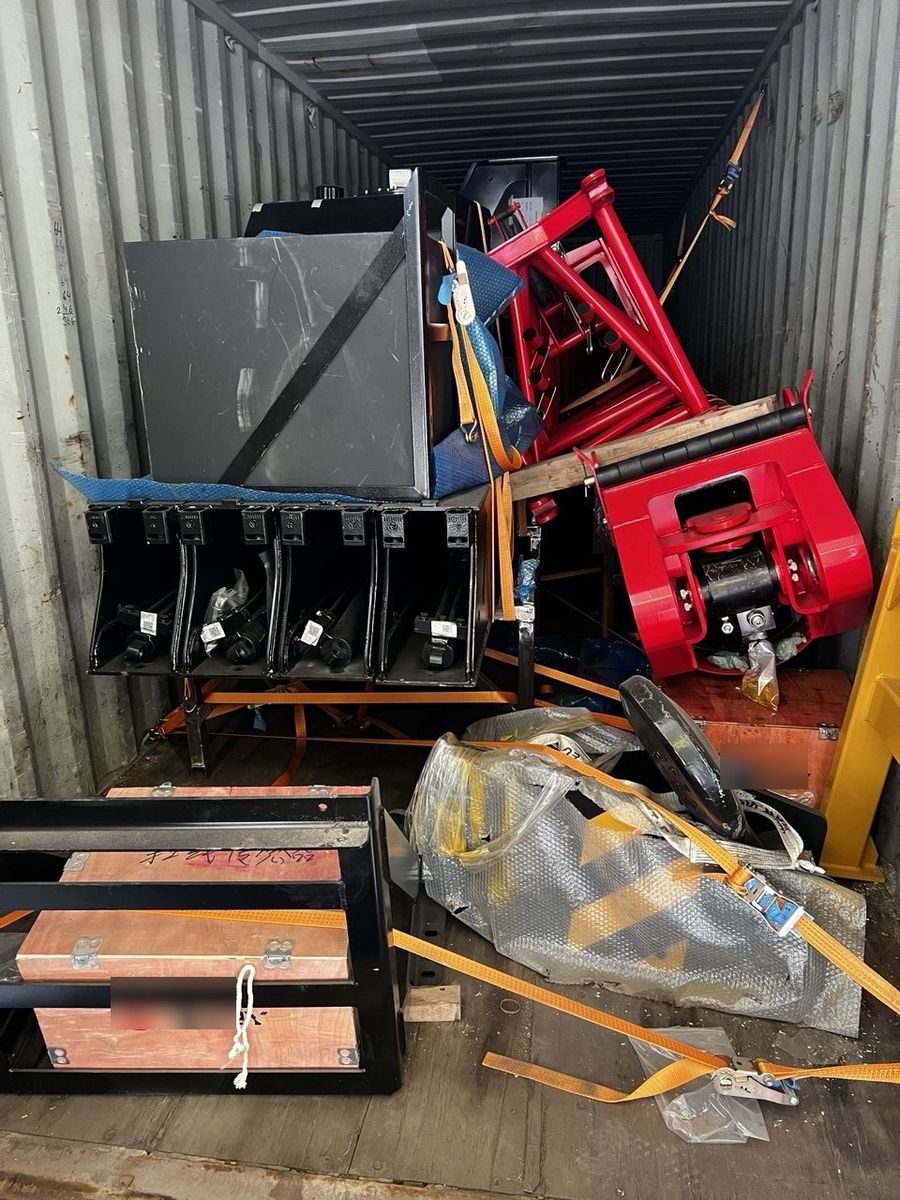
When we filed a claim, the shipper rejected it outright. With one argument: EXW.
And formally he was right. Under EXW the seller is not obliged to load the goods — the obligation is discharged by placing them at your disposal at their premises. Risk passed to the buyer before loading. Which means that when the seller does load, they do it at your risk, not their own. To reverse that, responsibility for loading and securing has to be a separate clause in the contract.
The person who physically tightened the lashings and the person answerable for them are, under EXW, different people. The seller loaded. The buyer pays. This is not a shipper's trick — it is the literal meaning of the rule you signed.
That is why EXW is not advised for machinery, equipment and anything where lashing decides the outcome. If you do take it, a clause on loading and securing is mandatory — ideally naming who inspects the result before the doors close.
Seven traps that cost money
All seven are set out in the callouts in the table above. In short, so you have something to check against before signing:
- EXW — there is no one to file the export declaration, and the seller loads and secures at your risk.
- FOB on a container — several days at the terminal when it is unclear whose risk it is.
- CIF — “insured” means minimum Clause C cover, and often only as far as the port.
- CPT and CIP — risk is yours from the first carrier, even though the seller pays the freight.
- DAP — unloading is yours, and so is demurrage during your own import clearance.
- DDP — the seller cannot reclaim the VAT and buries it in the price.
- FCA with a letter of credit — the seller holds no on-board bill of lading; the 2020 mechanism does not always work.
Which rule fits your case
- A container from China, you control the delivery — FCA. The seller clears export, the freight and documents are yours, the handover point is unambiguous.
- A first shipment with a new supplier — FCA or FOB. The point is not to hand the bill of lading to someone whose paperwork you have not seen yet.
- Groupage cargo — FCA. Under FOB the risk transfer point dissolves completely at consolidation.
- Oversized and project cargo — calculate separately for the scheme. Here the rule is chosen to fit the loading method, not the other way round.
- When you want to do nothing at all — DDP. But work out the VAT and remember that all control stays with the seller.
If you ship by in containers or by reefer, the Incoterms rule has to match how the cargo actually travels. It is the mismatch between the paperwork and the route that produces the invoices nobody planned for.
What changed in the 2020 edition
- DAT became DPU. The old name was tied to a terminal; the new one works for any place. If your contract says DAT, you are citing a revision that no longer exists.
- CIP moved to Clause A. The minimum insurance for CIP was raised to full cover. CIF was left at Clause C. Two neighbouring letters, two different levels of protection.
- FCA and the on-board bill of lading. A mechanism was added for letter-of-credit settlements. Lawyers call it half-finished — better to write it out separately.
Not sure which rule is in your invoice, or whether it suits your cargo at all? Send us the invoice and we will look at it together. Free of charge, even if you ship with someone else.