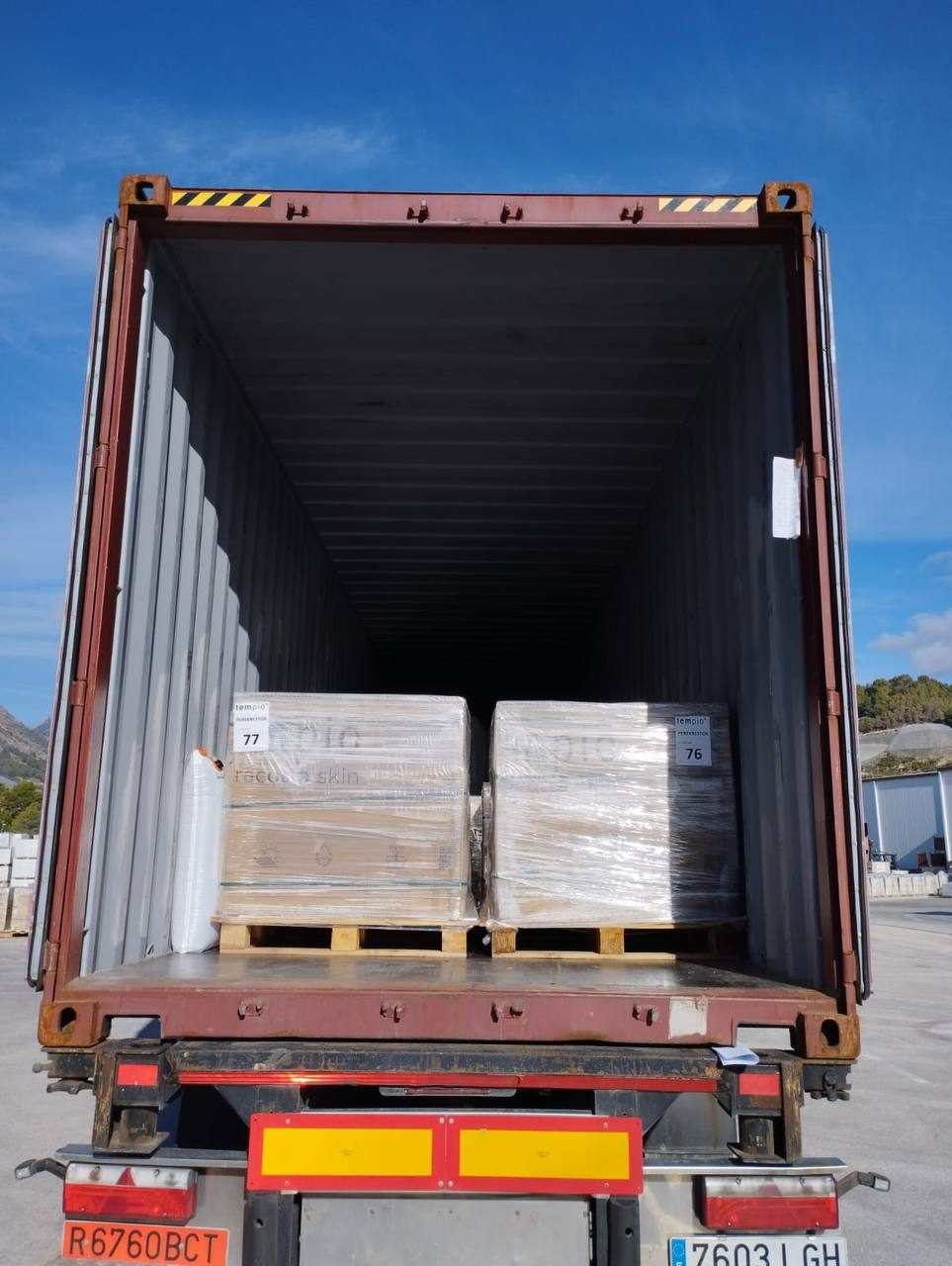
Peak season. There are no trucks on the Alicante–Dnipro route. And the client has 225 tonnes of facade tiles. The standard move is to join the queue for trucks and wait. We did the maths first.
Which is cheaper — a container or a truck?
In short: on heavy cargo a container is cheaper, on light and voluminous cargo a truck is. Weight per unit decides. On the road a truck is held back by weight control — you won’t carry more than ~22 t because of axle load. A container from an EU port travels into Ukraine by rail, and has no such limit — it takes up to ~28 t by specification. So with dense cargo (tiles, porcelain stoneware, metal) you need fewer containers and the invoice comes out lower. On light voluminous consignments and short legs the truck wins. Below is that same calculation on a real 225 tonnes of tiles, where containers came out €6,950 cheaper.
Tiles are heavy. And here it is not volume that decides but weight
Here is the key that usually gets missed: on the road a truck is limited by weight control — you won’t carry more than ~22 t because of axle load. A container travels from an EU port into Ukraine by rail, and has no such road limit — by specification it takes up to ~28 t (see the table below). This consignment of tiles was loaded at ~25 t — with a margin, and we count by the facts. The same cargo — fewer units — a smaller invoice. Let’s do the maths on these 225 tonnes:
| 🚛 Trucks (road) | 📦 Containers (with rail) | |
|---|---|---|
| Takes per unit | ~22 t (weight control limit) | up to ~25 t |
| Needed for 225 t | 11 trucks | 9 containers |
| Price per unit | €3 700 | €3 750 |
| Total | €40 700 | €33 750 |
| In a season of shortage | and you wait as well | it goes |
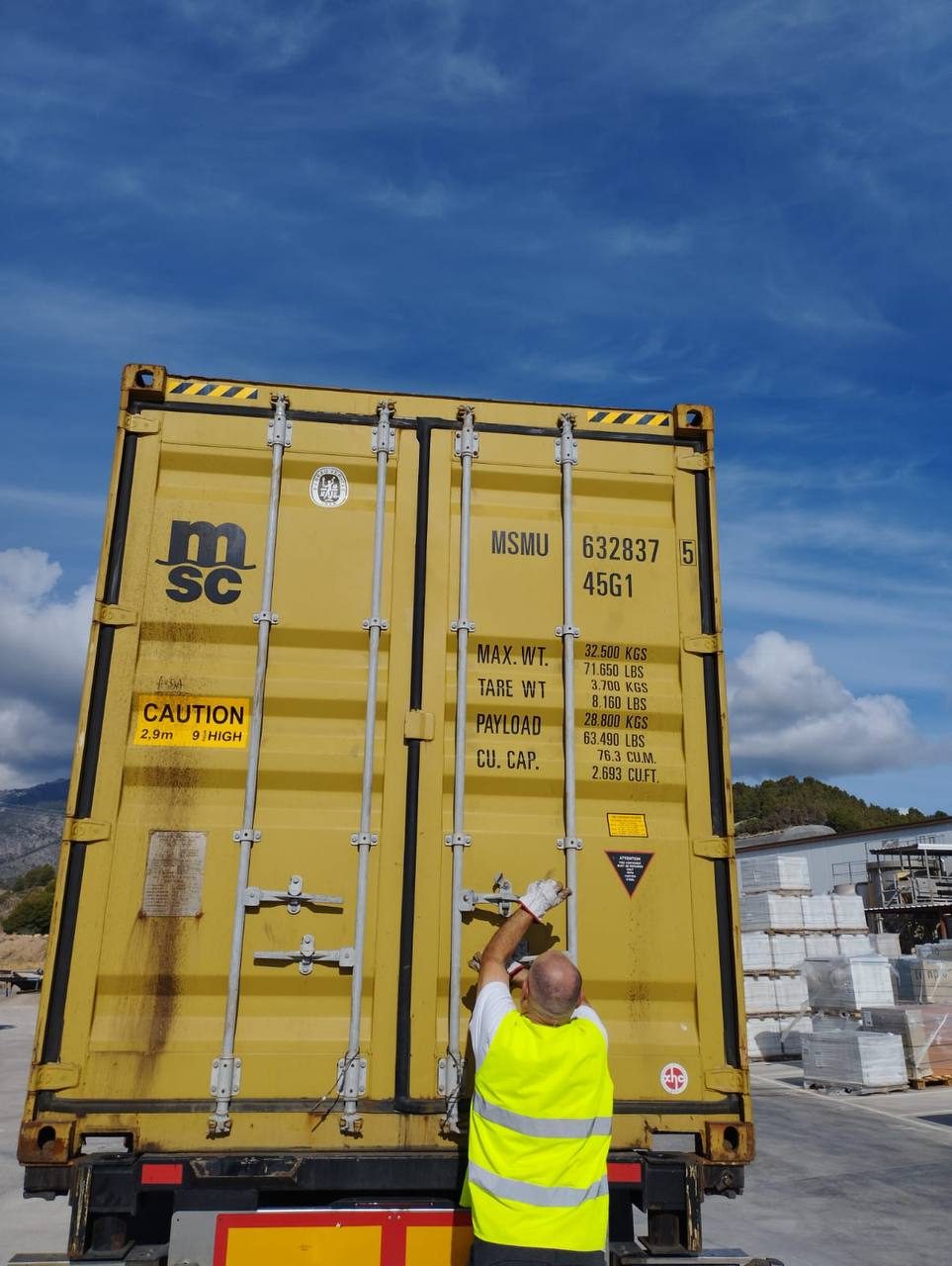
A “forty-footer” is not one type but two, with different limits. A standard 40'GP has the same maximum gross weight as a 20-footer (30,480 kg) but a heavier tare — so it takes less. A High Cube starts from a gross of 32,500 kg. Here are the rated figures:
| Type | Max gross | Tare | Payload |
|---|---|---|---|
| 20'GP (22G1) | 30,480 kg | ≈ 2,250 kg | ≈ 28,200 kg |
| 40'GP (42G1) | 30,480 kg | ≈ 3,750 kg | ≈ 26,700 kg |
| 40'HC (45G1) | 32,500 kg | ≈ 3,900 kg | ≈ 28,600 kg |
Tare differs between series by 100–200 kg, so the exact figure is always written on the doors of the specific container. On heavy cargo (tiles, porcelain stoneware, metal) a 20-footer is often better value than a 40'GP: the payload is bigger while you pay for less volume. The full table of tare, gross and payload for all types is in the article container payload. Want to size up your own cargo? Calculate it with the container loading calculator.
“But Chornomorsk isn’t working now”
True — back then the cargo went through Chornomorsk/Odesa, and they were working. Now, because of the blockade and shelling, we move containers through EU ports (Constanța, Gdańsk) and then by rail into Ukraine. The port changed — the rules did not. Rail still removes the weight control limit, so a container carries more than a truck. The maths of this case still holds today — only the entry point changes.
The detail that usually gets missed
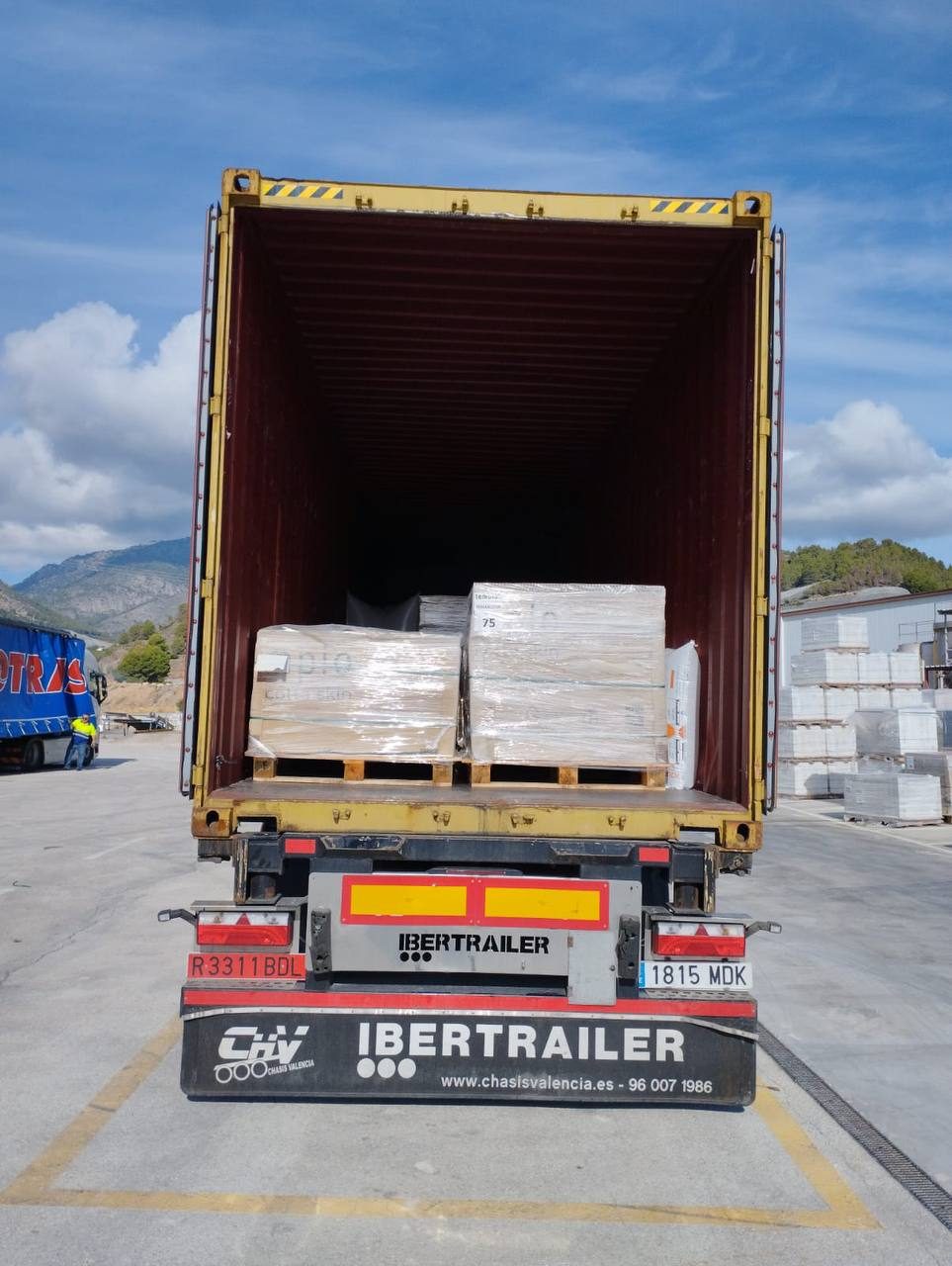
When a container is filled not completely, the pallets wander in transit and get damaged. We secure them with dunnage bags — “airbags” for the cargo. A small thing that saves the consignment from breakage.
When a container beats a truck
- heavy cargo — tiles, porcelain stoneware, metal, equipment;
- a large consignment;
- a season when there simply are no trucks;
- you need predictability and insurance.
On small light consignments and short legs a truck can be the smarter choice. Even if it isn’t a container.
When a truck is cheaper than a container
We calculate both options — and quite often the truck wins. Here is when:
- Light voluminous cargo. Furniture, empty packaging, polystyrene — you hit the container’s volume long before its weight. Here the “takes 28 t” advantage doesn’t work: there is nothing heavy to carry.
- A small consignment. One or two pallets. Keeping a whole container for that means paying for air. A truck or groupage is cheaper.
- A short leg. Türkiye, Europe by road — a truck goes direct, with no port transshipment and no rail leg. Fewer links — a lower price and faster.
- Urgently. When it has to be “yesterday” and the nearest sailing is two weeks away.
Cheap does not mean efficient. But a container is not always cheaper either. That is why we first ask about the cargo — weight, volume, leg, deadline — and tell you where your advantage is.
What the invoice consists of — and where the overpayment hides
When you compare two offers “by the price per container”, you are comparing the tips. The invoice is assembled from several parts, and the overpayment usually sits outside the freight:
- Ocean freight — what everyone sees and compares.
- THC at the ports of loading and destination — terminal charges at both ends.
- Surcharges — seasonal additions by the line (peak, holidays, port rerouting).
- The port → warehouse leg — road or rail from Constanța or Gdańsk to you.
- Customs clearance and the broker.
- Demurrage and detention — a day beyond the free time costs more than it seems. That is exactly where the saving on freight burns if the container gets stuck at customs. What these are is in the glossary of terms.
Comparing two offers only by the ocean freight line is like choosing a doctor by the price of the appointment. We show the full invoice — “turnkey including customs” — so that you see where your money actually is.