The short answer: the rated payload is 20'GP ≈ 28,200 kg, 40'GP ≈ 26,700 kg, 40'HC ≈ 28,600 kg. Yes, you read that right — a standard 40-footer takes less than a 20-footer. And the main thing the tables don’t say: how much a container withstands by specification and how much it is allowed to carry on the road are two different numbers. Both are below.
The full table: 20', 40' and 40'HC
Once, with all the figures you actually need for a cargo calculation — from internal volume to the number of euro pallets. These are the rated values of the ISO series 22G1, 42G1 and 45G1; a specific container may differ by 100–200 kg in tare.
| Parameter | 20'GP (22G1) | 40'GP (42G1) | 40'HC (45G1) |
|---|---|---|---|
| Internal length | 5.90 m | 12.03 m | 12.03 m |
| Internal width | 2.35 m | 2.35 m | 2.35 m |
| Internal height | 2.39 m | 2.39 m | 2.69 m |
| Internal volume | ≈ 33 m³ | ≈ 67 m³ | ≈ 76 m³ |
| Maximum gross weight | 30,480 kg | 30,480 kg | 32,500 kg |
| Tare (empty) | ≈ 2,250 kg | ≈ 3,750 kg | ≈ 3,900 kg |
| Payload (rated) | ≈ 28,200 kg | ≈ 26,700 kg | ≈ 28,600 kg |
| EUR pallets (1 tier) | 11 | 25 | 25 |
Swipe the table sideways →
“It fits” is not yet “you’re allowed to carry it”
This is where most tables stop and the client’s pain only begins. The payload in the specification is how much the container withstands. But on the road leg a separate, stricter limit applies — weight control by axle load. Because of it a road train with a container legally carries about 22 t regardless of the 28 in the specification.
So a 20-foot container that officially takes 28,200 kg turns into “22 tonnes maximum” on the road to your warehouse. The rest of the payload is out of reach while the container travels on wheels. There is one way around this limit: move the container by rail. Rail has no axle limit of the road — and that is where the full rated payload is realised. That is why a container from an EU port that continues by rail into Ukraine, actually carries more than a truck with the same cargo.
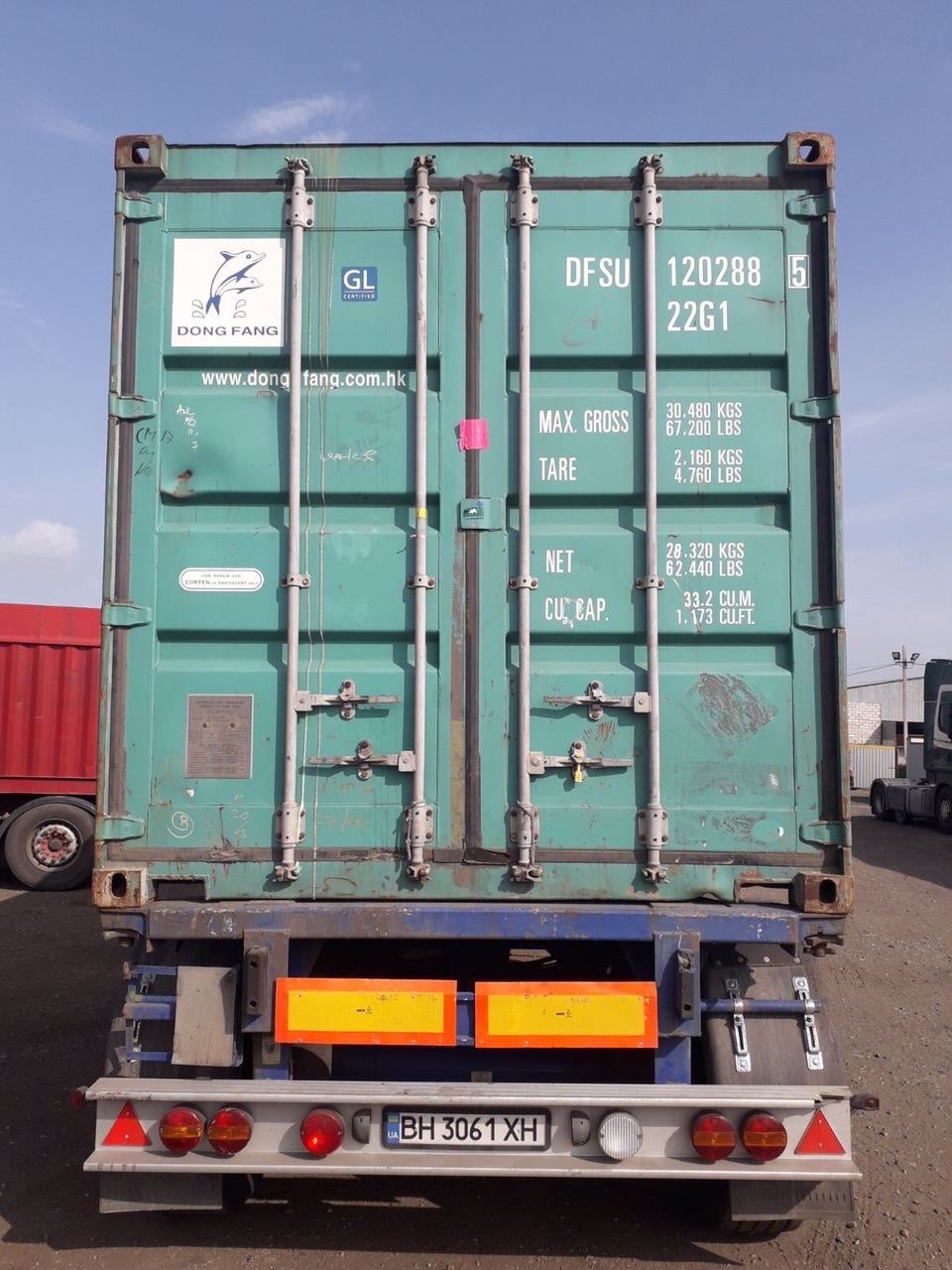
The plate on the doors is the main source of truth, not a table on the internet. Here is the marking of a 22G1 (that is a 20-footer): MAX GROSS 30,480 kg, TARE 2,160 kg, NET 28,320 kg, volume 33.2 m³. The same row of the table, only on a real container — and you can see that the small 20-footer takes the most usable weight among the standard ones. That is the rated maximum; on a truck, road weight control will cut it to ~22 t. This is exactly the figure we verify before loading heavy cargo.
Why a 40-footer takes less than a 20-footer
It sounds like a mistake, but it is physics. The maximum gross weight of a 20'GP and a 40'GP is the same — 30,480 kg. But the tare of the forty-footer is heavier by almost one and a half tonnes: more metal for a longer body. Payload is gross minus tare, so the longer container has less usable weight left: ≈26,700 kg against ≈28,200 kg.
The practical conclusion: on heavy cargo — tiles, porcelain stoneware, metal, equipment — a 20-footer is often better value. You hit the weight limit before you hit the walls of the container, so the extra volume of a forty-footer is simply paid for in vain. You can work out what your cargo will hit first — weight or volume — with the container loading calculator.
A 40'HC is a separate type, not a “big forty-footer”
A High Cube differs from a standard 40'GP not in length but in height: +30 cm (2.69 m against 2.39 m inside). That gives ≈76 m³ against ≈67 m³ — nine cubic metres more. The maximum gross weight is also higher, 32,500 kg, so the payload is bigger too (≈28,600 kg).
But the extra height does not add pallet places on the floor: both a 40'GP and a 40'HC take 25 euro pallets in one tier. The gain of an HC only works where the cargo can be stacked higher or where it is voluminous and light to begin with. HC is taken for bulky light cargo; for heavy cargo there is no sense in paying extra for cubic metres.
What to take for your cargo
- Heavy and dense (tiles, metal, equipment) — a 20'GP: maximum payload for less volume.
- Voluminous and light (furniture, packaging, consumer goods) — a 40'HC: more cubic metres for the same rate.
- Medium density — a 40'GP as the universal option.
- The road leg in Ukraine — budget for a limit of ≈22 t per truck, not the rated payload.
We calculate not “which container is bigger”, but which is cheaper for your particular weight, volume and leg. Sometimes the answer is not a container at all, but a comparison with a truck in money. We say honestly where your advantage is.